
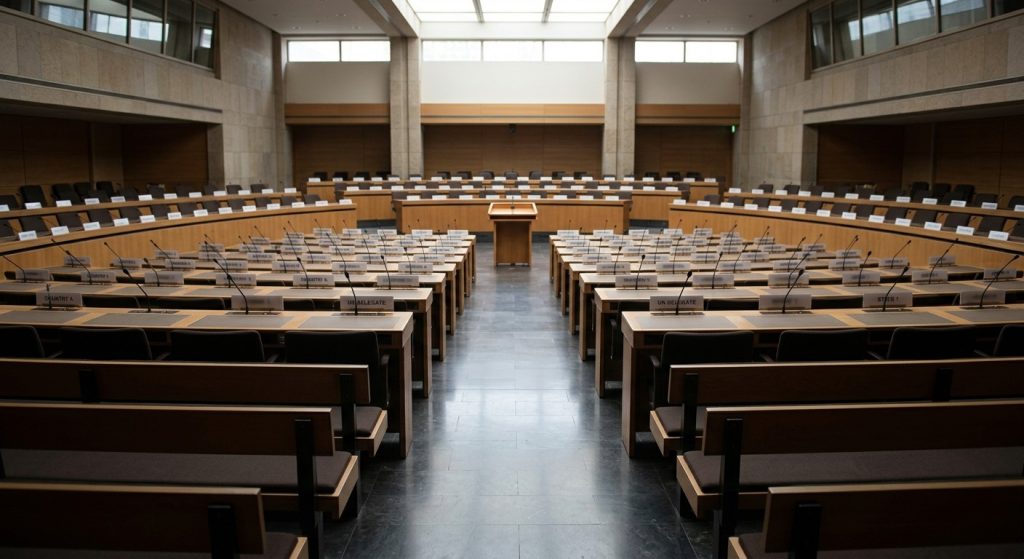
On 6 July 2026, the United Nations opened its first General Assembly-mandated forum on AI governance in Geneva. All 193 member states attended, the first time every country, developing and developed alike, has held a formal seat at an AI governance table. Secretary-General António Guterres named four priorities: common safety standards, human-rights red lines, capacity-building for developing nations, and environmental transparency. After two days, the forum closed with a co-chair summary. Not a treaty. Not an enforcement mechanism. The document records what governments agreed in the room. It does not bind any of them to act on it.
A pre-mortem applies five fixed questions to a public commitment before the outcome is known: what is being bet on, what single assumption underpins it, what was decided before governance existed, who carries it if it fails, and what would prove it worked. This piece applies that format to the public record of the first UN-mandated global AI governance dialogue, convened in Geneva on 6 and 7 July 2026.
The Bet
The UN’s bet is that convening all 193 member states repeatedly, Geneva first, New York in May 2027, produces a governance architecture capable of managing AI at global scale before the harms it is designed to prevent have already arrived. The mechanism is norm-setting: shared principles, common language, multilateral dialogue, with no enforcement powers and no treaty obligations. The independent scientific panel, co-chaired by Yoshua Bengio and Maria Ressa, published its first report on 1 July 2026, before the forum opened. Guterres proposed a Global Fund for AI and an AI Child Safety Pledge. Those are specific commitments, publicly made. The bet is that naming four priorities in a room of 193 governments changes what those governments do next.
The Assumption
The Dialogue’s credibility turns on a single calculation: that member states, with vastly different AI capabilities, legal systems, and strategic interests, will treat non-binding shared principles as a meaningful constraint on sovereign AI deployment decisions. The Dialogue produces a co-chair summary, not a resolution or treaty. A state that attends, agrees on human-rights red lines, and then deploys AI in ways that cross them faces no published consequence. At the Dialogue itself, the United States delegation argued that voluntary cooperation between government and industry, not binding rules, is the only approach agile enough to govern AI, a preference for exactly the model the Dialogue is testing. The architecture assumes that participation changes behaviour.
The Sequence
In 2017, Guterres called for global AI governance. In September 2024, the General Assembly adopted a Global Digital Compact that included AI provisions. In August 2025, the General Assembly established the Global Dialogue by resolution. The first session convened in July 2026. In the same period, the largest frontier AI models were trained, deployed at scale, and embedded in healthcare, finance, law enforcement, and defence, across countries that attended Geneva and agreed that safety is a priority. The Bengio-Ressa panel stated plainly that science currently cannot guarantee AI will not cause catastrophic harm as capabilities increase. The governance structure followed the deployment decisions. That is the sequence.
The Pager
Ambassador Egriselda López of El Salvador and Ambassador Rein Tammsaar of Estonia co-chaired the first session. Amandeep Singh Gill, UN Special Envoy for Digital and Emerging Technologies, coordinates the process. When a member state deploys an AI system that crosses the Dialogue’s own human-rights red lines, no document names the consequence. The co-chair summary records what was agreed. It is not a mechanism. The next session is May 2027 in New York. The question of who carries accountability between now and then has no published answer.
The Proof
Guterres named four priorities at Geneva. The measure that would prove any of them produced outcomes by May 2027 is at least one of these: a common safety standard that member states have adopted, a documented case where a human-rights red line prevented a harmful deployment, a committed capacity-building fund with named recipients, or an AI environmental reporting mechanism with verified data. The co-chair summary is the output the Dialogue committed to producing. An outcome requires a different commitment entirely.
Verdict
If the second session in New York, May 2027, produces a named accountability mechanism for at least one of Guterres’s four priorities, with a state or institution publicly committed to carrying it, the Geneva forum will stand as the first step of something with teeth. Without that, it stands as the moment 193 governments agreed that AI is the most consequential technology of the era, and scheduled a follow-up.