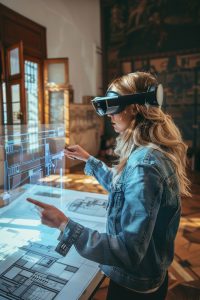
As technology continues to advance at an unprecedented pace, augmented reality (AR) and virtual reality (VR) are emerging as transformative tools in the realm of IT operations. These immersive technologies are poised to revolutionize how IT professionals manage, monitor, and optimize complex systems, offering unprecedented levels of efficiency, insight, and engagement. Here, we explore the key roles AR and VR are set to play in the future of IT operations and the potential benefits they bring to the table.
Enhancing Visualization and Monitoring
1. Real-Time Data Visualization
- AR and VR can transform traditional dashboards into immersive, 3D environments where IT professionals can visualize real-time data in a more intuitive and engaging way.
- Complex data sets, network topologies, and system performance metrics can be represented spatially, making it easier to identify patterns, anomalies, and potential issues.
2. Interactive Monitoring
- With AR, IT operators can overlay system status information onto physical servers, routers, and other hardware, allowing for quick identification of malfunctioning components.
- VR environments can replicate entire data centers, enabling remote monitoring and management as if the operator were physically present.
Streamlining Troubleshooting and Maintenance
1. Virtual Assistance and Guidance
- AR can provide on-the-spot, step-by-step instructions for troubleshooting and maintenance tasks, displayed directly in the technician’s field of view.
- Remote experts can use AR to guide on-site personnel through complex procedures, reducing downtime and minimizing errors.
2. Simulation and Training
- VR can create realistic simulations of IT environments for training purposes, allowing new hires to gain hands-on experience without risking disruption to live systems.
- IT teams can practice responding to various scenarios, such as cybersecurity threats or system failures, in a controlled, virtual setting.
Improving Collaboration and Decision-Making
1. Virtual Collaboration Spaces
- VR can create virtual meeting rooms where IT professionals from around the globe can collaborate in real-time, sharing ideas and working on projects as if they were in the same physical location.
- These virtual spaces can host interactive whiteboards, 3D models of IT infrastructure, and other collaborative tools to enhance teamwork.
2. Augmented Meetings
- AR can enhance face-to-face and remote meetings by overlaying relevant data, charts, and analytics in the participants’ visual field, making discussions more data-driven and informed.
- Decision-makers can interact with real-time data visualizations during strategy sessions, improving the quality and speed of decision-making.
Advancing IT Operations and Support
1. Predictive Maintenance
- AR and VR can integrate with AI-powered analytics to predict potential system failures and maintenance needs, allowing IT teams to proactively address issues before they escalate.
- Visualizing predictive maintenance data in an immersive format helps technicians prioritize tasks and allocate resources more effectively.
2. Enhanced User Support
- AR can assist IT support teams by providing contextual information about a user’s device and issues, displayed directly on their screen during support calls.
- VR can offer virtual helpdesks where users can interact with support technicians in a simulated environment, making support sessions more engaging and effective.
Real-World Applications and Success Stories
1. Data Center Management
- Companies are already using VR to create digital twins of their data centers, allowing remote monitoring and management of physical assets.
- AR is being utilized to provide real-time system status updates and maintenance instructions to on-site personnel, reducing downtime and improving efficiency.
2. Network Optimization
- VR environments are being used to simulate and optimize network configurations, helping IT teams visualize the impact of changes before implementing them in the real world.
- AR can assist in troubleshooting network issues by overlaying diagnostic information onto physical network components.
3. Cybersecurity Training
- VR is proving invaluable for cybersecurity training, allowing IT professionals to practice responding to simulated cyber-attacks in a risk-free environment.
- AR can provide real-time alerts and guidance during actual cybersecurity incidents, helping IT teams respond more quickly and effectively.
The integration of augmented reality and virtual reality into IT operations is set to redefine how IT professionals interact with their systems, data, and each other. By enhancing visualization, streamlining troubleshooting, improving collaboration, and advancing operational efficiency, AR and VR hold the potential to drive significant improvements in IT operations. As these technologies continue to evolve, their role in shaping the future of IT will undoubtedly grow, offering exciting opportunities for innovation and transformation. Embracing AR and VR in IT operations not only prepares organizations for the future but also sets a new standard for excellence in IT management.