
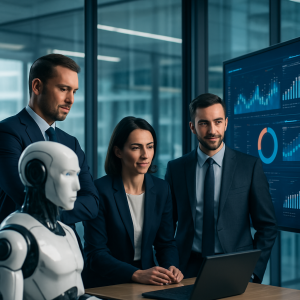
For years, the loudest voices in the tech world have been selling a very specific version of the future. It was a story where automation would eventually take over everything, from the production floor to the executive suite. The narrative was simple: machines would replace people.
But we are starting to see that this story was fundamentally flawed. The future is not about replacement. It is about reinforcement. It is not a battle of humans versus machines, but rather a partnership of humans with machines.
The real opportunity lies in augmentation, the practice of using technology to amplify human strengths rather than erase them. As Harvard Business Review has pointed out, the organizations that actually thrive are the ones where people and AI join forces to achieve outcomes that neither could manage alone. This is no longer just a technical choice; it is a strategic requirement for anyone leading a business today.
The Hidden Cost of Pure Automation
Many leaders have chased automation in a desperate pursuit of efficiency, only to find that the returns are diminishing. The reason is simple.
Automation without integration creates friction. It alienates your best employees, widens the skills gap, and strips away the very qualities that make an organization resilient: judgment, creativity, and adaptability.
MIT Sloan research shows that while AI is incredibly powerful, human oversight and context are still critical. When you remove people from the loop entirely, you do not just lose capacity. You lose the “why” behind the work. Brittle, fully automated systems tend to break the moment they are confronted with real world complexity. Automation without augmentation is just progress without people, and that is a dangerous path to walk.
A More Intelligent Way Forward
The goal should never be to make your workforce redundant. It should be to make them more capable.
Imagine AI that provides smarter insights rather than dictating decisions. Think about automation that handles the repetitive noise of the day so that your team has the space to do creative, high value work. This is the essence of augmentation. It delivers context rather than just raw data. It makes teams faster and sharper without making them obsolete.
McKinsey has noted that hybrid intelligence, where humans and machines work in tandem, consistently outperforms either one working in isolation. Innovation should never come at the expense of human value. It should be anchored in it.
The Strategic Case for Augmentation
If you are prioritizing augmentation in your business strategy, you are building for the long term. There are five clear advantages to this approach.
- Retaining Your Best People: Top performers do not want to do robotic work. Augmentation clears the low value tasks off their plate so they can focus on strategic contributions.
- Driving Real Adoption: People do not resist tools that make them better at their jobs. Augmentation creates collaboration instead of resentment.
- Building Resilience: Augmented teams combine the precision of a machine with the adaptability of a human. This is a massive advantage in a volatile market.
- Unlocking New Insights: Human intuition combined with machine analysis produces decisions that were previously impossible.
- Future-Proofing Your Culture: A Washington Post analysis confirms that AI is reshaping work more through augmentation than full replacement. By leaning into this now, you are building a culture that is ready for whatever comes next.
Leading the Shift
The organizations that will win tomorrow are the ones investing in people powered progress today. Automation alone can give you output, but only augmentation can deliver real impact.
Leaders today face a choice: you can optimize for the present by cutting people out, or you can elevate for the future by building them up. The leaders who define the next decade will not be the most automated. They will be the most augmented.