
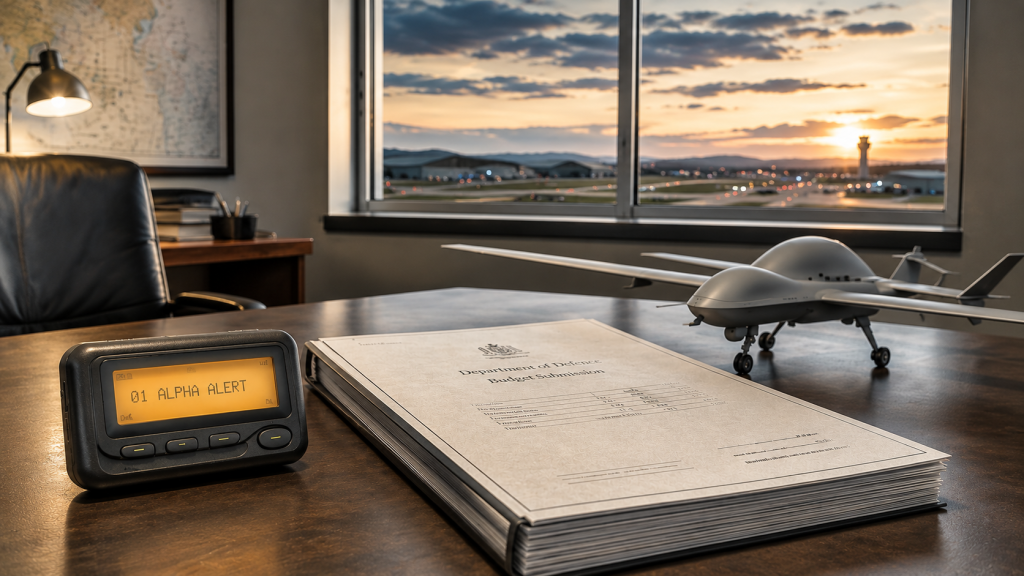
The Pentagon’s Replicator programme promised thousands of cheap autonomous drones in two years and delivered hundreds. The response has not been to wind it down. It has been to dissolve it, rebuild it as a new command inside Special Operations Command, and ask Congress for roughly 240 times the money. A programme that under-delivered on a lean, fast model is being re-attempted on a vast one, and the case for why the second structure succeeds where the first did not has not yet been made in public.
A pre-mortem asks the same five questions, every time, applied to a current programme before failure is possible rather than after. This is the third in the series. The first looked at vendor accountability in regulated finance. The second looked at clinical safety accountability in regulated healthcare. This one looks at execution accountability in defence procurement, the hardest delivery environment of them all. Different sector, similar structural shape: commitment moving faster than the architecture meant to hold it to account.
The Bet
The bet is that scale fixes what speed could not. Replicator was announced in August 2023 with a target of multiple thousands of all-domain attritable autonomous systems inside roughly two years, run by the Defense Innovation Unit on about a billion dollars across two fiscal years. It was deliberately lean, built to route around the traditional acquisition machine. By the deadline it had fielded hundreds. The reset, the Defense Autonomous Warfare Group, carries a 2027 budget request of about $54 billion, against roughly $226 million the year before. The technical bet is sound on its face: mass autonomy is where warfare is going, and the United States cannot afford to be slow to it. The harder bet, the one sitting under the headline number, is that money and a command structure fix what was an execution problem. Those are different things, and the launch treats them as one.
The Assumption
One belief is doing all the work: that Replicator’s shortfall was a problem of resourcing and structure, solvable with more of both. The documented failures point elsewhere. Systems were selected that proved unreliable, too expensive, or too slow to manufacture at the quantities needed. Some existed only as a concept when they were chosen. And the programme could not procure software able to orchestrate and command large, mixed swarms of different drones, which is the actual technical heart of autonomy at scale. None of those is a budget problem. A bigger budget buys more of the same systems and more of the same integration gap. If the diagnosis is wrong, the cure scales the disease.
The Sequence
Commitment came before the architecture, again. Replicator launched in August 2023. A second line of effort, focused on countering small drones, was added by a Secretary of Defense memo in September 2024. The original thousands-by-2025 deadline arrived with hundreds delivered. The programme was then consolidated into a joint interagency task force, dissolved, and rebuilt as the new autonomous-warfare group inside Special Operations Command, with the first acquisition under the new structure landing in January 2026, two counter-drone systems. Only in April 2026 did the Secretary tell the House Armed Services Committee that a sub-unified command for autonomous warfare was coming. The command meant to own this is still being stood up around a commitment already made. The funding tells the same story. Of that $54 billion, only about $1 billion is appropriated base money. The other $53 billion is a request, parked in a flexible five-year reconciliation pot that Congress has not yet passed. The headline number signals overwhelming commitment. In hard terms it is roughly a billion dollars in hand and fifty-three billion in hope. The intention is real. The money, for now, is one dollar in every fifty-four.
The Pager
Start with the credit, because it is real. The new group has a named director, Lt. Gen. Francis L. Donovan (USMC), with a clear command line and an appointment made by the Secretary himself. That is more named, senior accountability than most large defence programmes ever put on the public record, and it counts for something. The harder question is operational and specific. Standing policy requires appropriate levels of human judgement over the use of force. At swarm scale, with attritable systems acting at machine speed, who is the named individual accountable when one of them engages wrongly? The command line is clear. The accountability for the autonomous decision itself, at the scale this programme is built to reach, has not been framed in public. A command answers for a programme. It is a harder thing to say who answers for a single autonomous engagement when there are thousands of them in the air.
The Proof
The committed measures are input measures. Dollars requested, units contracted, the first systems bought. There is no public outcome measure for capability actually delivered, no cost per effective intercept, no fielded-and-working-at-scale figure with a date attached. This matters because the proof problem already bit once. Leadership called Replicator on track in 2024 and said it had made enormous strides in 2025, while the independent accounting found hundreds, not thousands. When the people who own the programme also own the definition of progress, optimism outruns delivery. Second-attempt scepticism is earned, not unfair. In eighteen months, the question of whether this worked will be answered by whoever holds the platform to define what delivered at scale means, and right now that platform is a budget request.
Verdict
This is a serious programme with serious people behind it. The strategic logic is correct, mass autonomy matters and slowness is its own risk. The accountability has a name and a rank, which is rare. The first systems have been bought and are heading to the field. None of that is in doubt.
What is unproven is whether a command and a budget can fix a problem that was about manufacturing maturity, software orchestration, and realistic system selection. A reorganisation addresses none of those by itself.
The action is concrete. Publish the outcome measure, not the input: a fielded-and-working-at-scale metric with a date, committed before the reconciliation money is spent, not after. Name the human accountable for autonomous engagement decisions at scale, not only the command that owns the programme. And diagnose the first shortfall in public before scaling, so the much larger second bet rests on a corrected understanding rather than a hope.
If the department publishes a delivered-at-scale outcome measure tied to a named owner, and solves the swarm-orchestration software problem it could not solve the first time, this becomes the programme that proves autonomous capability can be fielded at speed. Without both, it becomes the most expensive way yet found to relearn that money and reorganisation do not fix an execution problem.