
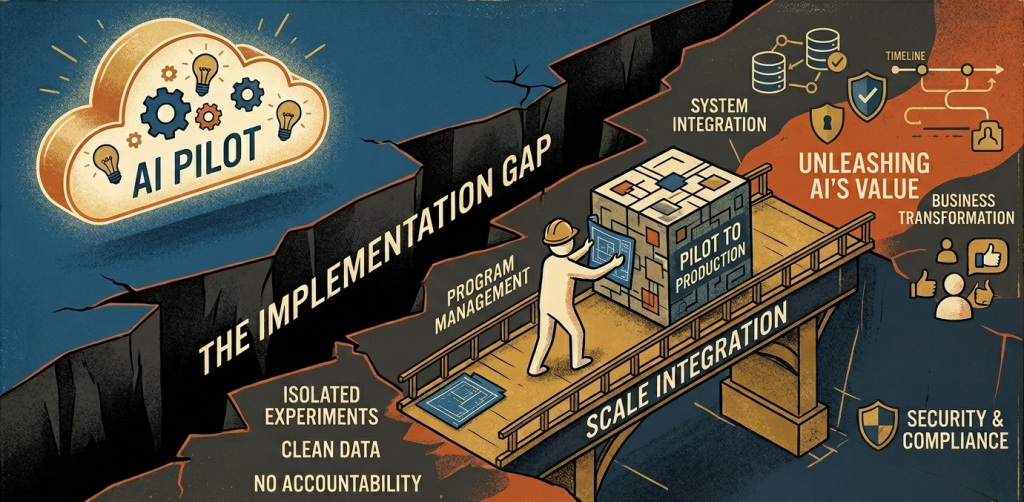
The technology works. That is almost never the problem.
Across most large organisations right now, AI pilots are running. Proof-of-concepts are producing results that make it into board presentations. Vendor demos are impressive. The innovation team is energised. And then, somewhere between the pilot environment and actual production, the whole thing quietly stops.
According to Deloitte’s 2026 State of AI report, drawn from more than 3,200 business leaders, only 25% of organisations have moved 40% or more of their AI experiments into live production. That number deserves to sit with you for a moment. Three in four organisations are running AI experiments that have not become operational capability. The technology is not the constraint. Something else is.
You Have Seen This Before
If you have been in transformation long enough, this pattern is not new. It is the same pattern from every large ERP programme that never fully went live. Every data platform that became a reporting tool rather than a decision-making engine. Every digital transformation that delivered a new front end while leaving the back-office processes unchanged.
The technology becomes the story because it is visible, measurable, and exciting to talk about. The execution conditions that determine whether the technology actually delivers are harder to photograph and harder to put in a slide: ownership, integration, adoption. So they get managed as a substream, treated as implementation detail, and quietly become the reason the initiative stalls.
This is not an AI problem. It is an execution problem that has found a new context.
Ownership Is Not a Committee
The single most common structural failure in AI deployments is diffuse accountability. Someone owns the technology. Someone owns the data. Someone owns the security review. Someone owns the business case. Nobody owns the outcome.
Committees do not drive production deployments. They review them, adjust them, query them, and occasionally approve them. The organisations that close the gap from pilot to production consistently have a single named individual who is accountable for whether the capability lands in the hands of users, works as intended, and is actually being used. Not a steering group. Not a centre of excellence. One person with the authority and the obligation to make it happen.
This is not a preference for a particular organisational design. It is what the evidence shows, consistently, across every transformation context where the accountability question has been seriously investigated. Singular ownership is not sufficient on its own. But its absence is almost always present when a deployment fails.
The Metric You Are Probably Not Tracking
Most AI initiatives are measured on model accuracy, inference speed, and technical performance. These are valid measures of whether the technology works. They are not measures of whether the initiative is delivering value.
The question that actually determines success is adoption. Is the tool being used? By how many people? How often? Has it changed the decision they were making, or is it an additional step they complete before making the same decision they always made?
Deloitte’s 2026 data found that despite AI tools being available to approximately 60% of the workforce in organisations surveyed, fewer than 60% of those workers actually use them regularly. Access is not adoption. Availability is not value. If you do not have an adoption metric from day one, not a plan to measure adoption eventually but an actual metric that someone is accountable for, you are measuring the wrong thing and you will find out too late.
Scope Is Your Production Variable
There is a reason pilots succeed and production deployments struggle. A pilot can be run by a small team, in a controlled environment, with curated data, limited integrations, and a sponsor who is personally invested in making it work. Production is fundamentally different. It requires integration with existing systems that were not designed for this. It requires security and compliance review. It requires monitoring, maintenance, and the ability to handle the variability of real-world use at scale.
The organisations that consistently move from pilot to production do one thing differently: they scope production more narrowly than they scoped the pilot. Not because they are being unambitious, but because a narrow, fully integrated, fully adopted capability that actually works is worth ten pilots that demonstrated potential and then stalled in the transition.
Start smaller in production than you think you need to. Prove the integration. Prove the adoption. Then expand. The ambition for scale is valid. The timing of it is where most programmes get it wrong.
The Pattern Closes the Same Way Every Time
The 54% of organisations that Deloitte found expecting to move the majority of their AI experiments to production within three to six months are not describing a plan. They are describing an aspiration. The organisations that will actually close that gap are the ones that address the execution conditions, not the technology stack.
Singular accountability. Adoption as the primary metric. Scope narrowed deliberately in production. None of these are technology decisions. They are leadership decisions, and they can be made before the next pilot is commissioned.
The technology is ready. The question is whether the organisation is.